
Lake County Court Records After Arrest
After a Lake County arrest, the jail roster may show booking charges, docket fields, bond amounts, and holds. Those details are not always the final court charges. A prosecutor may file a complaint, a municipal court may handle a misdemeanor or initial felony probable-cause matter, a felony may be bound over to Common Pleas, or a grand jury may return an indictment. The court record is the better source for filed charges, hearing dates, amendments, pleas, dismissals, convictions, and sentencing.
Custody and booking details belong first in Lake County jail inmate records. Booking photos belong with Lake County jail mugshots. Court records after a jail arrest answer a different question: what case opened after the arrest, which court has it, and what the current legal status is.
Find Lake County Court Records After Arrest
Lake County has several official court record paths. The Lake County Clerk of Courts keeps civil, felony criminal, and domestic relations pleadings. The Clerk public-records page says Common Pleas case search covers cases from 1990 to present and document images from 2017 to present. Municipal court cases are split among Mentor, Painesville, and Willoughby Municipal Courts. These courts handle misdemeanors, traffic, ordinance cases, and early felony proceedings before a felony moves to Common Pleas.
- Start with the jail roster docket field if a docket appears in the PDF entry.
- Search the municipal court tied to the arresting agency for misdemeanors, traffic, OVI, ordinance, and early felony matters.
- Search the Lake County Clerk/Common Pleas system for felony cases, bindovers, indictments, and Common Pleas docket records.
- Open the case record and compare charge text, case number, bond orders, status, and hearing dates.
- Use the Clerk public-records request process for certified copies or documents not available online.
The Clerk public-records page documents the online case-search and copy-request path.
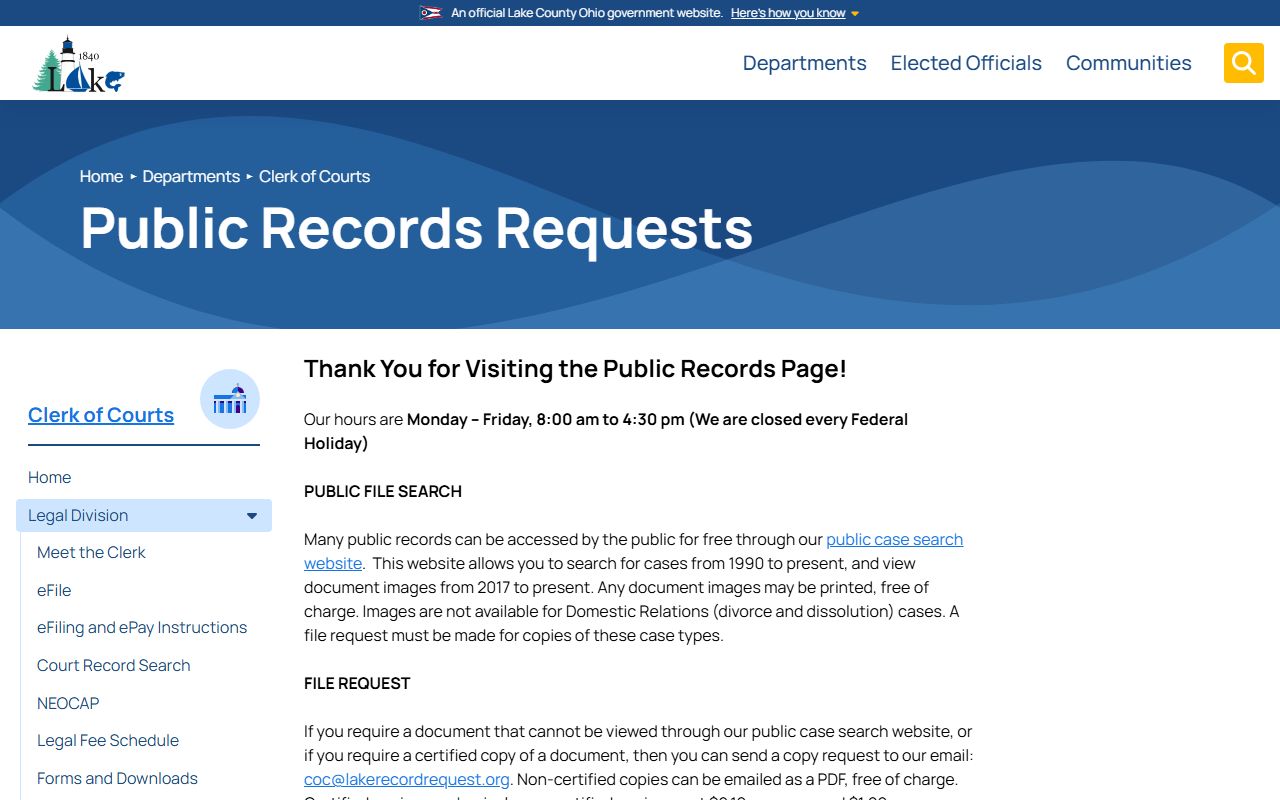
The Clerk process matters when an online image is missing, a certified copy is needed, or the case has records that require staff handling.
Lake County Court Search Fields
The Common Pleas portal was blocked during automated inspection in the research file, but county pages identify its scope. Willoughby Municipal Court's Benchmark portal was inspectable and shows how a municipal search can work. Painesville and Mentor also publish court search or warrant pages. Search the court that matches the agency, city, charge level, and case stage.
| Court Source | Fields / Scope | Notes |
|---|---|---|
| Lake County Clerk / Common Pleas | Cases from 1990-present; images from 2017-present | Used for felony criminal cases and Common Pleas pleadings. |
| Willoughby Municipal Court Benchmark | All, name, case number, date opened/closed, civil, criminal, traffic | Captcha required; includes case types such as CRA, CRB, OVI, and traffic. |
| Painesville Municipal Court | Case search and active warrant list | Use for Painesville-area municipal cases and warrants. |
| Mentor Municipal Court | Record search and active warrant report | Use for Mentor municipal cases and preliminary felony matters. |
Lake County Arrest Charging Documents
Formal court records after a jail arrest begin with a charging document. The name of that document depends on the charge level and the path the case takes. A complaint can start a misdemeanor case or an early felony matter. An information is a prosecutor-filed charging document. An indictment is returned by a grand jury and is common in serious felony cases. These documents may use wording that differs from the jail roster's booking charge.
| Document | Filed By | Common Use | What to Compare |
|---|---|---|---|
| Complaint | Officer or prosecutor | Misdemeanor or initial felony case | Charge text, statute, court, and case number. |
| Information | Prosecutor | Felony filing where permitted | Filed charge and degree after prosecutor review. |
| Indictment | Grand jury | Serious felony or bound-over case | Counts, ORC sections, degree, and arraignment date. |
Lake County Charge Status
Charges can change after arrest. A jail roster entry may show the arresting or holding charge. The prosecutor may amend, reduce, add, dismiss, or replace that charge. A court docket is the better place to read the filed charge status. A court status also helps separate an accusation from a conviction, which matters for employment, housing, licensing, and personal record review.
| Status | What It Means |
|---|---|
| Pending | The charge remains open and has not reached final disposition. |
| Amended or Reduced | The charge wording, level, or count changed after prosecutor or court action. |
| Dismissed | The charge was ended without a conviction on that count. |
| Nolle Prosequi | The prosecutor chose not to proceed on the charge at that time. |
| Convicted | A guilty plea, finding, or verdict was entered. |
Bond After Lake County Arrest
Bond information can appear in both the jail roster and court records. The Lake County jail FAQ says to call 440-350-5602 to ask about a particular bond amount and whether the bond may be posted at the jail. Callers may be directed to the court or arresting agency. The FAQ also says release after bond may take minutes or hours and can depend on court paperwork. There are no fixed release hours.
| Bond Type | How It Works |
|---|---|
| Cash Bond | Money posted directly when a cash bond has been set by the court or permitted agency. |
| Surety Bond | A licensed bond agent may post where court rules allow it. |
| PR / Own Recognizance | Release based on a promise to appear, usually by court order. |
| No-Bond Hold | Ordinary payment will not release the person until the court or hold agency acts. |
| Detainer or Hold | Another agency, warrant, probation, parole, or court case may block release. |
Lake County Arrest Warrants
Warrants often explain why a jail arrest happened. The Sheriff's Court Services Division says the sheriff is responsible for apprehension on warrants issued by Common Pleas, Domestic Relations, Juvenile Court, Painesville Municipal Court, and the other municipal courts. The division processes about 1,000 warrants each year and apprehends about 400 felony wanted subjects and 350 misdemeanor wanted subjects annually. The Warrant Division is listed at 440-350-5620, 24 hours.
The Sheriff's Most Wanted page is a curated warning page, not a full warrant search. Painesville Municipal Court and Mentor Municipal Court publish active warrant lists, and both warn that information may be delayed up to 24 hours and must be validated before enforcement. Willoughby warrant questions should be checked through Willoughby Municipal Court access or the court directly.
Lake County Charges vs Convictions
An arrest, a charge, and a conviction are separate stages. A jail arrest shows that a person was taken into custody. A charge is an accusation filed or tracked in court. A conviction means a guilty plea, finding, or verdict was entered. Court records after a Lake County arrest should be read with that distinction in mind.
| Charge | Conviction | |
|---|---|---|
| Stage | Accusation or filed count | Final guilty result on a count |
| Proof level | Probable cause or filing standard | Proof beyond a reasonable doubt or guilty plea |
| Can change | May be amended, reduced, added, or dismissed | Can be appealed, sealed, expunged, or modified only through legal process |
Lake County Sealed Expunged Records
Ohio sealing and expungement law can affect public access to some criminal records. ORC 2953.32 addresses sealing or expunging eligible conviction records. ORC 2953.33 addresses records after not guilty findings, dismissals, no bills, or pardons. Eligibility depends on the case, the charge, the disposition, waiting periods, and court orders. The court record should be checked for the actual order, not assumed from the fact that a case ended favorably.
| Sealed | Expunged | |
|---|---|---|
| Public visibility | Hidden from most public access after court order. | Destroyed, deleted, or treated as not existing where the statute permits. |
| Agency access | Some official access may remain under law. | Access is more limited, but depends on the statute and order. |
| Best proof | Court sealing entry. | Court expungement entry. |
Restricted Lake County Court Records
Ohio public-records access is broad, but not absolute. ORC 149.43 allows exemptions for categories such as medical records, confidential law-enforcement investigatory records, trial-preparation records, juvenile or sealed material, and records prohibited from release by state or federal law. Court staff or the Clerk may require a request for records that are not visible online, and certified copies can involve per-page and certification fees listed in the research file.
Important: Court records after an arrest are not consumer reports and should not be used for FCRA-covered screening decisions.
Public Record Search
Sponsored Results